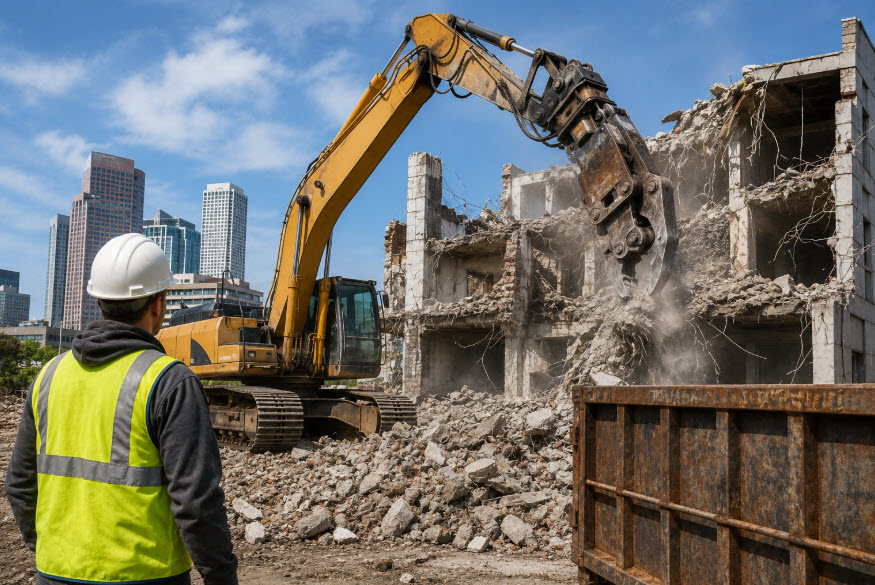
Demolition contractors take on some of the most demanding work in Colorado’s construction industry, from interior selective demolition and residential tear-downs to larger commercial and structural demolition projects. Contractors working throughout Denver, Colorado Springs, Fort Collins, Castle Rock and communities across the Front Range may operate heavy equipment, remove debris, work around neighboring structures and coordinate employees and subcontractors in constantly changing job-site conditions.
Those operations create significant insurance exposures. Falling debris can damage nearby property, employees can be injured around machinery, underground utilities can be struck and demolition work can uncover asbestos, lead, mold or other potentially hazardous materials. Contractors may also operate dump trucks, excavators, skid steers and trailers while transporting equipment and debris between job sites. The right insurance can help protect the business while also helping satisfy project contracts, certificates of insurance and liability-limit requirements.
How Much Does Demolition Contractor Insurance Cost in Colorado?
In 2026, a smaller Colorado demolition contractor may pay approximately $3,000 to $10,000 or more per year for general liability insurance, although pricing can vary substantially. Interior selective demolition and smaller residential projects may fall toward the lower end, while structural demolition, larger commercial projects, work around occupied buildings and higher-hazard operations can cost considerably more to insure.
A broader demolition contractor insurance program may cost approximately $10,000 to $30,000 or more per year once workers compensation, commercial auto, equipment coverage, pollution liability and higher liability limits are included. Larger demolition companies handling substantial structural, industrial or environmental projects may spend $40,000 to $100,000 or more annually. Pricing depends heavily on annual revenue, payroll, project size, equipment values, vehicle use, subcontractor costs, claims history and the exact type of demolition work performed.
What Type of Insurance Coverage Does a Demolition Contractor Need?
Most Colorado demolition contractors should begin with general liability insurance written for their actual demolition operations. This coverage can help with certain third-party bodily injury and accidental property damage claims. Examples can include debris damaging an adjacent building, a visitor being injured around the job site or demolition work accidentally damaging property that was not intended to be removed.
Demolition companies frequently own or transport skid steers, compact excavators, breakers, generators, saws and other expensive machinery. Tools and equipment insurance can help protect eligible movable equipment against covered losses while it is transported, stored or used away from the contractor’s main location. Contractors operating dump trucks, pickups, service vehicles or other road vehicles should also consider commercial auto insurance.
Colorado demolition contractors with employees will generally need workers compensation insurance. Larger contractors and companies working under commercial construction contracts may also need commercial umbrella insurance when projects require liability limits above their underlying policies.
Why Can Pollution Liability Be Important for Demolition Contractors?
Pollution exposure can become an important concern in demolition because contractors may encounter asbestos, lead, mold, contaminated soil, chemicals, fuel or other hazardous materials while removing structures and debris. Standard general liability policies commonly contain pollution exclusions or limitations, so contractors should not assume every environmental loss arising from demolition work will be covered.
Contractors pollution liability may help address certain covered claims involving pollution conditions, cleanup expenses, bodily injury and property damage. This coverage can become especially important when a contractor knowingly performs environmental demolition, encounters contaminated materials or works on older industrial and commercial properties. The exact need depends on the services performed and the policy language.
What Do Insurance Companies Look at When Insuring a Demolition Contractor?
Insurance companies typically want a detailed breakdown of the demolition work being performed. Interior selective demolition may be evaluated very differently from complete structural demolition. Underwriters may ask what percentage of revenue comes from residential, commercial and industrial projects, whether buildings remain occupied during the work and the maximum height, size and value of structures being demolished.
Carriers may also review excavation, debris hauling, heavy-equipment use, prior claims, employee experience and subcontractor costs. Operations involving high-rise structures, bridges, blasting, significant environmental remediation or other unusual hazards may require specialized insurance markets beyond those used for conventional interior or structural demolition.
How Do Subcontractors Affect Demolition Contractor Insurance?
Demolition contractors often use subcontractors for trucking, asbestos abatement, environmental remediation, excavation and other specialized services. Insurance companies may ask how much work is subcontracted and whether subcontractors maintain their own general liability, workers compensation and pollution coverage when appropriate.
Written subcontractor agreements and current certificates of insurance are particularly important on demolition projects. General contractors, developers and property owners may also require the demolition contractor to provide additional insured status, waiver of subrogation or specific liability limits before work begins.
Does Debris Hauling Affect Demolition Insurance?
Many demolition contractors haul debris away from job sites using company-owned dump trucks or trailers. This creates a commercial auto exposure in addition to the work taking place at the demolition site. Vehicle size, driver records, hauling radius, number of trucks and whether the contractor transports only its own debris or also hauls for others can all affect underwriting.
Contractors should clearly describe their hauling operations when requesting insurance. A company using one pickup and trailer can present a very different risk than an operation running multiple heavy dump trucks between demolition sites, transfer stations and disposal facilities.
Insurance Companies That May Cover Colorado Demolition Contractors
Castle Rock Insurance is a Colorado insurance agency that works with its partners to help demolition contractors explore coverage through standard and specialty commercial insurance markets. Depending on the contractor’s operations, project size, payroll, equipment, vehicle use, subcontractor exposure, pollution risk and claims history, options may be available through demolition-focused programs such as Amwins and other specialty construction and environmental insurance markets. Because carrier appetite can vary substantially between interior demolition, structural demolition and environmental work, Castle Rock Insurance and its partners can help review the operation and compare available coverage options.
Get Your Demolition Business Insured Today!
Whether your company performs interior demolition, residential tear-downs or larger commercial demolition projects, Castle Rock Insurance and its partners can help you explore insurance options for your liability, employees, vehicles, equipment and environmental exposures. Contact us today to compare available coverage options and request a Colorado demolition contractor insurance quote.