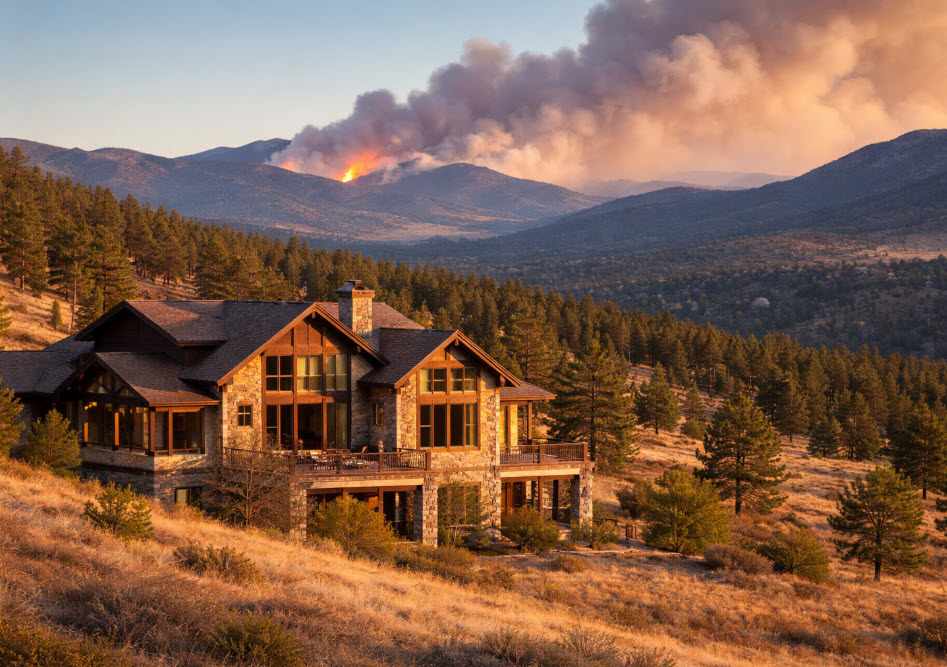
Finding homeowners insurance for a Colorado property with elevated wildfire exposure can be difficult, but living in a fire zone does not automatically mean you need specialty insurance. Some homes can still qualify for standard homeowners coverage, especially with a well-maintained roof, good defensible space, managed vegetation and reasonable access to fire protection.
Wildfire underwriting has become increasingly property-specific. Insurers may evaluate the home, surrounding vegetation, construction materials, slope, road access, fire protection and completed mitigation. Two homes in the same Colorado community can therefore receive very different underwriting decisions.
For broader pricing information, our guide to Colorado homeowners insurance costs in 2026 explains how wildfire, hail, rebuilding costs and other factors affect premiums statewide.
How Much Does Homeowners Insurance Cost in a Colorado Fire Zone?
Homes with elevated wildfire exposure generally cost more to insure. In 2026, approximately $6,500 to $15,000+ per year is a reasonable planning range for many higher-risk Colorado homes when standard-carrier coverage is available. Larger homes and more difficult properties can cost considerably more.
If standard coverage is unavailable, excess and surplus or specialty coverage can commonly reach approximately $7,000 to $22,000+ per year. Pricing depends on replacement cost, roof condition, surrounding fuels, terrain, fire protection and other underwriting factors. Specialty policies may also have different deductibles and restrictions, so compare coverage rather than price alone.
Already Have Standard Carrier Coverage and Your Rates Are Going Up? Keep It Because You Are Lucky
If your wildfire-exposed home already has standard-carrier coverage, think carefully before giving it up because of a rate increase. Many higher-risk Colorado properties struggle to qualify for the standard market at all. If your current carrier is willing to continue providing solid coverage, you may be in a better position than you realize.
Another standard insurer may decline the property, leaving excess and surplus or specialty coverage as the alternative. Those policies can be considerably more expensive, with higher-risk Colorado homes commonly reaching $7,000 to $22,000+ per year.
Before switching, compare deductibles, roof settlement terms, exclusions and coverage as well as premium. In many Colorado fire zones, keeping good standard coverage can make more financial sense than giving it up for modest short-term savings.
What Do Insurance Companies Look at in a Wildfire Area?
Insurers increasingly evaluate individual properties rather than relying only on ZIP codes. Underwriters may consider surrounding vegetation, defensible space, roof and siding materials, decks, slope, road access, nearby structures and proximity to responding fire services. Some carriers also use wildfire models incorporating property and community characteristics.
A home with a newer fire-resistant roof, managed vegetation and good emergency access may be viewed differently from a nearby property surrounded by dense fuels or difficult terrain.
Your Roof and Defensible Space Can Make a Difference
The roof is especially important because it faces both wildfire and Colorado hail. Insurers may consider its age, condition, material, fire resistance and impact resistance. Noncombustible or Class A-rated roofing can be an important part of wildfire resilience. Learn more about how Colorado insurers evaluate roof age and roofing materials.
Defensible space matters too. Managing vegetation, removing combustible materials near the structure, cleaning roofs and gutters and reducing fuels beneath decks can improve a property’s wildfire profile. The Insurance Institute for Business & Home Safety provides research-based recommendations through its Wildfire Prepared Home guidance.
Keep roof records, photographs and documentation of completed mitigation. Good documentation can make the underwriting review easier.
Can Fire Monitoring and Home Automation Help?
Monitored smoke detectors, heat sensors, connected fire alarms and sprinkler systems can help identify fires quickly and potentially reduce the severity of a loss. Some insurers also offer protective-device discounts for qualifying fire, security and smart-home systems.
These devices do not replace defensible space or other wildfire mitigation, but early detection can still be valuable for fires that begin in or near the home. Learn more about home security, automation and fire monitoring insurance discounts.
Can Bundling Home and Auto Help in a Fire Zone?
In some cases, yes. Certain standard insurers may be more willing to consider a wildfire-exposed home when they can also insure the household’s vehicles. Bundling does not guarantee approval, but it can improve the available options when the property is otherwise reasonably close to underwriting guidelines.
A multi-policy discount may also reduce overall cost. Learn more about Colorado home and auto insurance bundle discounts.
Colorado’s Wildfire Insurance Rules Changed in 2026
HB25-1182 took effect July 1, 2026 and created new requirements affecting insurers that use certain wildfire risk models, catastrophe models or scoring methods. The law addresses property and community mitigation, wildfire risk information, mitigation adjustments and appeals.
Homeowners can review the Colorado General Assembly’s HB25-1182 page or read our guide to Colorado’s HB25-1182 wildfire insurance law. The law does not guarantee lower premiums or require insurers to approve every mitigated property.
When Is Specialty Fire-Zone Insurance Needed?
Some properties fall outside standard-carrier guidelines even after mitigation. Very high wildfire exposure, dense vegetation, steep terrain, difficult emergency access or remote locations can significantly limit standard options.
In those situations, excess and surplus or specialty markets may provide coverage. These policies are important alternatives, but premiums, deductibles and coverage terms can differ significantly from standard homeowners insurance.
Buying a Home in a Colorado Fire Zone?
Start the insurance process well before closing. Eligibility can depend on property characteristics that are difficult to determine from a real estate listing, and the seller’s existing insurance does not guarantee the same coverage will be available to a new owner.
Be prepared to provide the roof age and material, inspection information, wildfire mitigation details and vehicle information if you are open to bundling.
Hail Still Matters in Colorado Fire Zones
Wildfire may be the biggest concern for a mountain or foothill property, but Colorado hail exposure does not disappear in a fire zone. Insurers may evaluate the same roof for both wildfire ignition and severe hail.
Our guide to hail damage and homeowners insurance in Colorado explains why roof age, impact resistance and wind and hail deductibles remain important.
Why Is Colorado Homeowners Insurance So Expensive?
Wildfire is only part of the problem. Severe hail, higher construction and labor costs, roof losses and stricter underwriting are also contributing to higher Colorado premiums. Learn more about why homeowners insurance is so expensive in Colorado.
Get a Colorado Fire Zone Insurance Quote
If standard homeowners coverage is not available or your property is difficult to place because of wildfire exposure, Castle Rock Insurance and its partners can help compare available options. We can determine whether the home may fit a standard carrier, whether bundling could improve the available options or whether a specialty market should be considered.