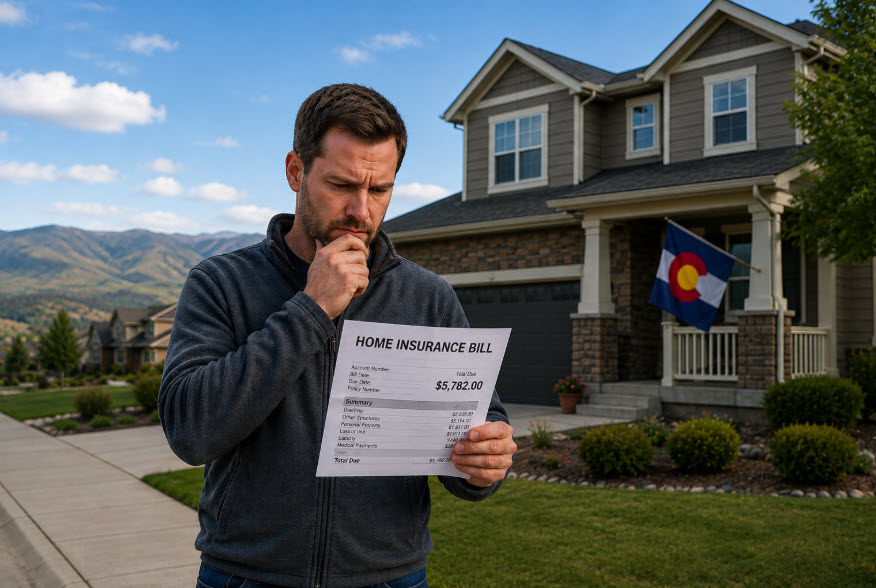
If your homeowners insurance bill has gone up in Colorado, you are definitely not alone. Premiums remain high in 2026 because several expensive risks are affecting the market at the same time, including hail, wildfire exposure, rising rebuilding costs and increasingly detailed property underwriting. Insurance companies are also paying closer attention to individual homes, particularly roof condition, catastrophe exposure, prior claims and other characteristics that can affect both pricing and eligibility.
For many Colorado homeowners, a reasonable 2026 planning range is approximately $4,200 to $5,200 per year. Some households will pay less while others will pay considerably more depending on the home, location, rebuilding cost, roof, wildfire and hail exposure, past claims, credit, deductibles and the insurance company offering coverage.
Why Is Homeowners Insurance So Expensive in Colorado?
Colorado combines several costly property risks in one insurance market. Hail affects heavily populated communities along the Front Range and Eastern Plains, while wildfire creates a different challenge in foothill, mountain and wildland-urban interface areas. Wind, snow, freezing temperatures and severe weather create additional losses, while repairing or rebuilding damaged homes has also become more expensive.
This helps explain why premiums can increase even when a homeowner has never filed a claim. Insurance companies consider not only an individual property’s history, but also what future losses could cost and the broader catastrophe exposure surrounding the home.
Hail Remains One of Colorado’s Biggest Insurance Costs
Wildfire gets significant attention, but hail remains one of the largest contributors to homeowners insurance costs across much of Colorado. Colorado insurance officials have estimated that hail risk can account for approximately 26% to 54% of homeowners insurance premiums depending on the county. A severe storm can damage thousands of roofs, siding systems, windows and vehicles within a relatively concentrated area.
This is why insurers pay so much attention to roof age, roofing material, impact resistance and wind and hail deductibles. Our guide to hail damage and homeowners insurance in Colorado explains how this risk can affect both coverage and cost.
Your Roof Can Have a Major Impact on Your Insurance
The roof has become one of the most important parts of a Colorado home from an underwriting perspective. Insurance companies may consider its age, material, condition, impact resistance and estimated replacement cost when determining eligibility and coverage terms. An older roof can reduce the number of available carriers or affect deductibles and how future roof claims are settled.
Roofing material matters as well. Asphalt shingles, metal, concrete or clay tile and synthetic roofing systems can respond differently to hail, wind and wildfire. Our guide explains how roof age and material affect homeowners insurance in Colorado and why keeping documentation of roof replacements and major repairs can be valuable.
Insurance Companies Are Using More Technology to Evaluate Homes
Home insurance underwriting is becoming increasingly data-driven. Insurers and their technology providers can use aerial imagery, public records, computer vision, catastrophe models and other property-level information to evaluate roofs, surrounding vegetation and other characteristics without relying solely on a traditional in-person inspection. Carriers use these tools differently, and a technology-generated concern may still be reviewed by an underwriter or lead to a request for additional documentation.
Remote imagery can also lack important context. Solar panels, shadows, staining, vegetation or other exterior features can sometimes make a property more difficult to interpret from above. Our article on how AI and aerial imagery are changing home insurance risk assessments explains what homeowners should know if technology appears to be influencing an underwriting decision.
Wildfire Is Creating a Different Insurance Challenge
Wildfire risk is more concentrated geographically than hail, but it can have a much larger effect on an individual home’s eligibility. Properties in foothill, mountain and wildland-urban interface communities may face higher premiums, fewer standard-market options or additional underwriting requirements. Insurers may evaluate vegetation, defensible space, slope, road access, building materials, surrounding fuels and access to fire protection.
Because wildfire underwriting can be extremely property-specific, two nearby homes can receive very different decisions. Homeowners having difficulty because of wildfire exposure can learn more about Colorado fire zone and wildfire insurance and the additional considerations that can apply to higher-risk properties.
Colorado’s Wildfire Insurance Rules Changed in 2026
HB25-1182 took effect July 1, 2026 and created new requirements for certain property insurers that use wildfire risk models, catastrophe models or scoring methods in underwriting and pricing. Among other provisions, the law provides homeowners with greater transparency around wildfire risk classifications, mitigation and certain insurance decisions.
The law does not prevent insurers from using wildfire models and does not guarantee cheaper coverage after mitigation. It does, however, provide homeowners with more information and a process for challenging certain wildfire risk determinations. The legislation is available through the Colorado General Assembly.
Colorado Is Putting More Focus on Stronger Roofs
Colorado is also putting more emphasis on reducing property losses before they occur. Senate Bill 26-155 created the Strengthen Colorado Homes Enterprise in 2026, supporting efforts aimed at stronger and more resilient homes, including qualifying roof improvements. This reflects a broader shift toward reducing the severity of future property losses rather than addressing insurance affordability only after damage occurs.
A newer or more resilient roof does not automatically guarantee a lower premium or approval with every insurance company. Discounts and underwriting guidelines vary, but stronger roofing and documented property improvements may become increasingly relevant as insurers evaluate Colorado homes.
Rebuilding a Colorado Home Costs More Than It Used To
Another major driver of homeowners insurance premiums is reconstruction cost. Homeowners insurance is generally based on what it would cost to rebuild the insured structure after a covered loss, not what the property would sell for on the real estate market. Labor, roofing, lumber, electrical work, plumbing, debris removal, contractor availability and current building requirements can all affect that estimate.
This is why dwelling limits and premiums can rise even when the homeowner has not remodeled or filed a claim. If rebuilding the same house would cost substantially more today than several years ago, the amount of insurance needed to reconstruct it may increase as well.
How Do Past Claims Affect Homeowners Insurance?
Claims history can affect both pricing and eligibility. Insurers may consider the type of loss, how recently it occurred, the amount paid and whether several property claims have occurred within a relatively short period. One isolated claim does not necessarily make a home difficult to insure, but multiple recent losses can have a larger underwriting impact.
Claims are still only one part of the picture. A homeowner with no recent claims can experience a significant renewal increase because of catastrophe exposure, higher rebuilding costs, changing roof requirements or broader changes in an insurer’s Colorado rates and underwriting appetite.
Can Credit Affect Homeowners Insurance Rates in Colorado?
Credit can also influence homeowners insurance pricing. Many insurers use a credit-based insurance score as one rating factor, which is not necessarily the same score displayed by a bank or consumer credit-monitoring service. The effect varies because insurance companies use different rating models and may weigh credit information differently.
If your credit profile has improved substantially since your policy was written, comparing options may be worthwhile. Our guide explains how credit can affect insurance rates in Colorado and why the impact can differ between carriers.
Do Not Compare Home Insurance on Premium Alone
A cheaper homeowners policy is not necessarily a better policy. Colorado homeowners should pay particular attention to deductibles, especially separate wind and hail deductibles that may be expressed as a dollar amount or percentage. Roof settlement provisions, replacement-cost coverage, water damage limitations and important exclusions can also make a significant difference after a loss.
When comparing quotes, consider what you would actually be responsible for after a serious hail, fire or water claim rather than focusing only on the annual premium. A modest annual savings may not be worthwhile if the alternative policy comes with a much larger deductible or more restrictive coverage.
Why Can Insurance Companies Quote the Same Home So Differently?
Every insurance company has its own rates, underwriting guidelines, catastrophe models and appetite for particular properties. One carrier may be comfortable with a certain roof age, wildfire exposure or claims history while another may decline the same home or charge substantially more. Your current renewal is therefore one company’s evaluation of the risk, not necessarily a reflection of what the entire Colorado insurance market will charge.
This difference has become particularly important as underwriting becomes more property-specific. If one carrier substantially increases a premium, changes coverage or decides not to renew a home, it can be worthwhile to determine whether another insurance company evaluates the property differently rather than assuming the same result will apply everywhere.
Can Bundling Home and Auto Insurance Help?
Bundling remains one practical way Colorado households may be able to improve overall insurance pricing. Many companies offer multi-policy discounts when home and auto coverage are written together, and some insurers may be more interested in the overall household when they can insure both the property and vehicles. A bundle is not automatically the best option, however, so total premium, deductibles, limits and coverage should still be compared together.
How Can Colorado Homeowners Lower Their Insurance Costs?
Start with the characteristics you can realistically improve. A newer or more resilient roof, documented wildfire mitigation, appropriate vegetation management and other meaningful property improvements may improve how some insurers evaluate the home. Keep invoices, photographs, permits and other documentation showing significant improvements so they are available if an insurer requests additional information.
Review deductibles carefully and compare insurance options periodically, particularly after a large renewal increase or a meaningful change to the home or household. Most importantly, compare the actual coverage being offered rather than treating homeowners insurance as a commodity where the lowest annual premium is automatically the best option.
Will Colorado Homeowners Insurance Get Cheaper?
There are some encouraging developments. Colorado is putting more emphasis on resilient roofing, wildfire mitigation and transparency around catastrophe-risk models, all of which could help reduce losses and improve the insurance market over time. However, Colorado will continue to face hail, wildfire and expensive rebuilding costs, so homeowners should not expect premiums to quickly return to the levels seen several years ago.
What If Your Homeowners Insurance Is Nonrenewed?
A nonrenewal does not necessarily mean a home is uninsurable. It may reflect one carrier’s roof requirements, wildfire appetite, catastrophe exposure or other underwriting guidelines. Homeowners should first determine the specific reason for the decision and whether updated photographs, inspection reports, roof documentation or mitigation information could address the concern.
If the insurer will not reconsider, another insurance company may evaluate the property differently. Our guide explains what to do if your homeowners insurance is dropped in Colorado and what to consider when looking for replacement coverage.
Get Help Comparing Colorado Homeowners Insurance
Colorado homeowners insurance has become more complicated, but meaningful differences still exist between insurance companies. A carrier that is competitive for one property may not be the right fit for another, particularly when roof age, wildfire exposure, claims history or other underwriting concerns are involved.
Castle Rock Insurance and its partners work with homeowners throughout Colorado and coordinate with a variety of insurance resources to help evaluate available options. Whether you are dealing with a large renewal increase, buying a home, replacing an older roof or having difficulty finding coverage because of wildfire exposure or another underwriting issue, we can help you compare available options and understand how different insurance companies may evaluate your situation.