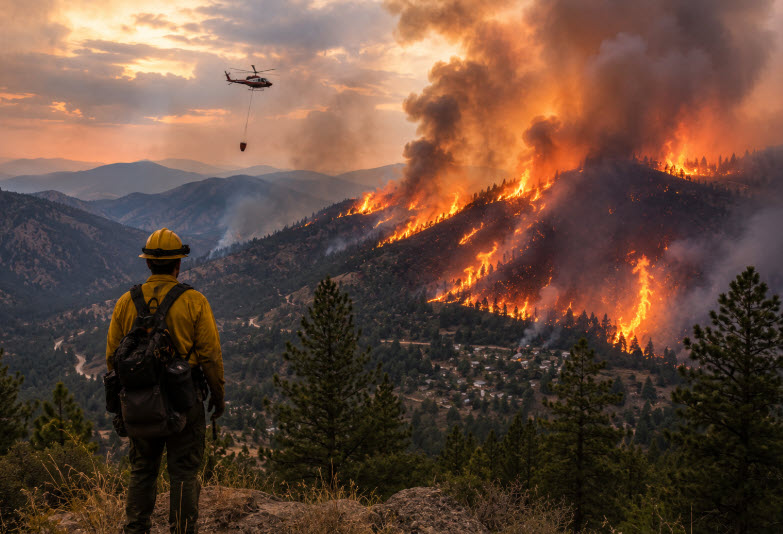
Colorado’s 2026 wildfire season has shown how quickly conditions can change across the state. After weeks of extreme heat, dry air and rapid fire growth, recent monsoon rains have brought some welcome relief. The added moisture has helped crews slow several large fires, reinforce containment lines and reduce fire activity in many areas. Although the recent rain has improved conditions for firefighters, wildfire season is not over and warmer, drier weather could still return later this summer.
Even with the change in weather, the impact of this year’s fires has been significant. Colorado has experienced 13 large active wildfires, with more than 200,000 acres burned statewide. The Aspen Acres Fire in Pueblo and Custer counties grew to more than 93,000 acres and destroyed at least 263 homes, making it one of the state’s most destructive wildfires since the Marshall Fire. State officials have estimated that response, suppression and early recovery expenses associated with Colorado’s four largest fires have already reached approximately $266 million. Once damaged homes, businesses, infrastructure, insurance claims and wider economic effects are considered, the overall cost may ultimately be much higher.
Behind those figures are families who have lost homes, communities that have faced evacuations and emergency crews who have worked through extreme heat, heavy smoke and rapidly changing conditions. Tragically, four wildfire responders lost their lives during the 2026 season. Their deaths are a heartbreaking reminder of the risks accepted by firefighters, pilots, emergency managers and other first responders working to protect Colorado communities. Their courage, along with the resilience of affected residents, reinforces the importance of wildfire preparation, home mitigation and careful insurance planning.
How Wildfires Are Changing Homeowners Insurance in Colorado
Colorado’s homeowners insurance market has changed considerably as wildfire losses, severe weather and rebuilding costs have increased. Many insurers now use satellite imagery, aerial photography and property-level risk models when deciding whether to issue or renew a policy. They may consider nearby vegetation, slope, roof materials, defensible space, road access, fire protection resources and the amount of business they already insure in the surrounding area. These changes have contributed to stricter underwriting, higher premiums and more non-renewals, including for some homeowners who have never filed a claim.
Standard carriers continue to insure homes throughout Colorado, but many have become more selective in foothill, mountain and open-space communities. A non-renewal does not necessarily mean there is a serious problem with the property. It may instead reflect a carrier’s broader decision to reduce its wildfire exposure within a particular region. Homeowners who maintain their property, complete recognized mitigation work and provide clear documentation may have more options, although no individual improvement can guarantee approval or a lower premium.
How Colorado Is Responding
Colorado has also taken steps to make wildfire underwriting more transparent. Under Colorado’s wildfire insurance law, HB25-1182, affected insurers must provide homeowners with more information about wildfire risk scores, available mitigation discounts and the ways those factors may influence pricing, eligibility or non-renewal decisions. The law also creates a process for homeowners to challenge certain wildfire risk classifications when they believe the information does not accurately reflect their property or completed mitigation work. It does not guarantee renewal or lower premiums, but it gives homeowners greater insight into how wildfire-related insurance decisions are made.
How Fire Hardening Can Improve Your Insurance Options
Fire hardening focuses on reducing the likelihood that a home will ignite during a wildfire. Homeowners can begin by creating defensible space, trimming branches away from the roof, removing dead vegetation, cleaning roofs and gutters and moving firewood or other combustible materials farther from the house. The first five feet around the structure are especially important. Replacing bark mulch, dense shrubs and other combustible landscaping near the foundation with gravel, stone or other fire-resistant materials can help reduce the chance that flames or wind-driven embers will reach the home. Homeowners who would like a more detailed assessment can learn about property evaluations and mitigation planning through Front Range Fire Defense.
The construction and condition of the home also matter. A Class A fire-rated roof, ember-resistant vents, tempered windows, noncombustible siding and fire-resistant decking can improve a property’s ability to withstand wildfire exposure. Roof condition is particularly important in Colorado because insurers often evaluate its age, materials and overall condition for both wildfire and hail risk. Our guide to how roof condition can affect homeowners insurance explains why these details may influence eligibility, deductibles and pricing.
Mitigation does not guarantee that a carrier will offer coverage or reduce the premium, but documented improvements can strengthen the way a property is presented during underwriting. Homeowners should keep inspection reports, dated photographs, contractor invoices and receipts for completed work. Some insurers consider individual property mitigation, community wildfire programs, Firewise participation or local risk assessments when reviewing eligibility and available discounts. Providing this information at the beginning of the quote process can help an agent identify carriers that are more receptive to completed wildfire improvements.
What to Do If You Receive a Non-Renewal
If you receive a non-renewal notice, begin reviewing your options as early as possible. Read the letter carefully, ask the current carrier for the specific reason and confirm the date coverage will end. Then gather your existing policy, recent claims history, roof information and documentation of any property improvements or wildfire mitigation. An independent insurance agency can use those details to determine whether another standard carrier may be willing to consider the home. Our guide explaining what to do after a homeowners insurance non-renewal in Colorado provides a more detailed look at the process.
It may also help to complete a property inspection and address reasonable mitigation recommendations before submitting new applications. In higher-risk areas, some insurers prefer to evaluate the entire household rather than write a standalone homeowners policy. Combining the home with auto, umbrella or other coverage may improve placement opportunities with certain carriers, although bundling does not guarantee acceptance. Homeowners can learn more about the potential advantages in our guide to home and auto insurance bundle discounts.
When Standard Coverage Is Not Available
Homeowners should generally explore standard insurance carriers first because these policies often provide broader coverage and more competitive pricing. When standard carriers decline a property because of severe wildfire exposure, limited access, unusual construction or prior losses, an excess and surplus lines policy may provide another option. These specialty policies are designed for risks that fall outside standard underwriting guidelines, but they may include higher deductibles, different coverage terms and additional exclusions. In 2026, some high-risk Colorado homes may see specialty homeowners premiums ranging from approximately $7,000 to $22,000 or more per year, depending on replacement cost, location, vegetation, slope, fire protection, roof condition and completed mitigation.
Every home is evaluated individually, so the property’s specific characteristics matter more than a statewide average. Homeowners with limited options can review our guide to high-risk fire zone and wildfire insurance in Colorado. The Colorado FAIR Plan may also provide limited last-resort coverage for eligible property owners who are unable to secure appropriate insurance through the traditional private market.
Get a Homeowners Insurance Quote in a High-Risk Area
Finding homeowners insurance in a wildfire-exposed area can require additional time and documentation, but a high-risk location does not automatically mean coverage is unavailable. Whether you have received a non-renewal notice, are closing on a home in an unfamiliar community, are purchasing a property in a higher wildfire-risk area or simply want to review your current policy, it is wise to begin the insurance process early. Castle Rock Insurance works with trusted insurance professionals throughout Colorado who can review standard carriers, specialty markets and broader household coverage options based on the property’s individual characteristics. Providing complete property details, existing policy documents and evidence of completed mitigation can make the review more accurate and help identify the widest reasonable range of coverage options.