
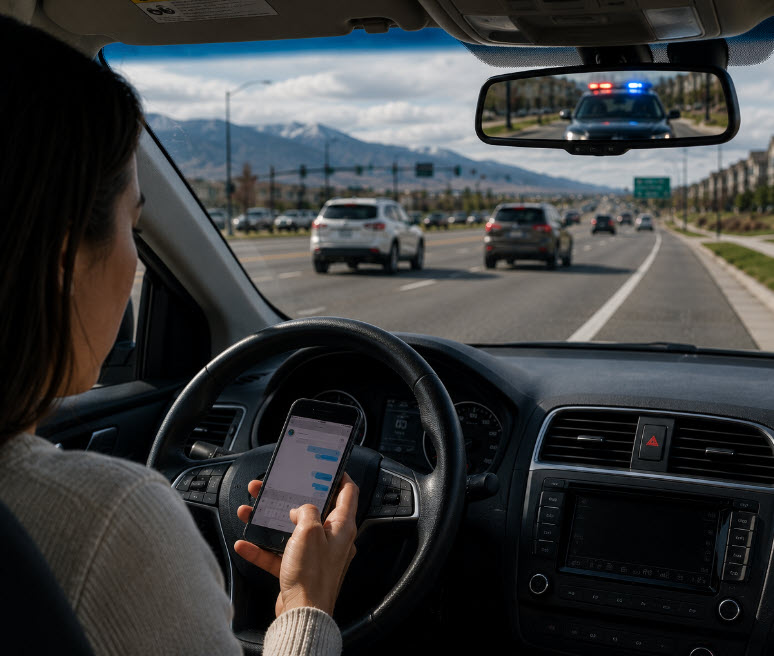
Texting and driving is a serious risk on Colorado roads. A quick glance at a message, changing a song or checking directions may only take a few seconds, but that can be enough time to travel hundreds of feet without giving the road your full attention. Whether you’re driving along I-25 through the Denver metro area, navigating busy streets in Castle Rock or traveling on a mountain highway, Colorado drivers already deal with congestion, changing weather and unpredictable road conditions. Looking at a phone adds another dangerous distraction at exactly the wrong moment.
Distracted driving also goes well beyond texting. Reading notifications, holding a phone, scrolling through social media or manually entering directions can take a driver’s eyes, hands or attention away from the road. Colorado’s hands-free driving law, which took effect January 1, 2025, generally prohibits drivers from holding or manually using a mobile electronic device while driving. The goal is straightforward: reduce preventable crashes by keeping drivers focused on driving.
How Dangerous Is It to Text and Drive in Colorado?
The numbers show how widespread distracted driving remains. CDOT reports that distracted driving continues to be a major factor in crashes and fatalities across the state. In 2025, Colorado State Patrol investigated 3,778 crashes involving inattentive drivers, nearly 9% fewer than the year before. CDOT’s 2025 Driver Behavior Survey also found that 33% of Colorado drivers reported picking up a phone to read a message, while 23% reported picking up a phone to send one. Over the longer term, 676 people were killed in distracted-driving crashes in Colorado between 2014 and 2024, according to CDOT distracted-driving data.
Texting is particularly dangerous because it can create several types of distraction at the same time. Your eyes leave the road, your hands may leave the wheel and your attention shifts away from surrounding traffic. NHTSA notes that reading or sending a text can take a driver’s eyes off the road for about five seconds. At 55 mph, that is comparable to traveling the length of a football field without watching the road. Nationally, distracted-driving crashes killed 3,208 people and injured more than 315,000 people in 2024, according to the latest NHTSA distracted-driving statistics.
There are encouraging signs that driving habits in Colorado may be improving. Smartphone-based driving data analyzed after the hands-free law took effect found that distracted driving declined 4.7% from 2024 to 2025 and dropped 8.3% during the first month of the new law. Researchers estimate that the reduction may have prevented nearly 600 crashes, more than 400 injuries and six deaths statewide. CDOT’s hands-free law analysis suggests that even relatively small changes in driver behavior can have a meaningful impact on road safety.
What Does Colorado’s Hands-Free Driving Law Prohibit?
Colorado’s law generally prohibits drivers from holding or manually using a cellphone or other mobile electronic device while driving. That includes holding a phone to make a call, reading or sending messages and manually interacting with apps. The restriction also applies when temporarily stopped in traffic or at a stoplight. Hands-free accessories, securely mounted devices and integrated vehicle systems can still be used for certain functions without physically holding the device. Drivers can review Colorado’s hands-free requirements for additional guidance.
The law includes limited exceptions for certain situations and workers, including emergency communications, first responders, utility workers and other authorized personnel performing specific duties. Drivers in legally parked vehicles are also treated differently. For most Colorado drivers, the safest approach is to program navigation, choose music and handle messages before getting on the road. If something on your phone requires your attention, find a safe place to park first.
What Happens If You Get a Texting and Driving Ticket in Colorado?
Colorado’s hands-free law carries both financial and driving-record consequences. A first violation starts with a $75 fine and two license points, while repeat violations can result in higher fines and additional points. First-time violators may be able to have the charge dismissed by showing proof that they purchased a hands-free accessory after receiving the citation. Enforcement has also increased significantly. In 2025, Colorado State Patrol issued 216% more citations for electronic-device violations than it did in 2024, according to CDOT distracted-driving data.
The ticket itself may only be one part of the financial impact. Insurance companies can consider traffic violations, driving history, claims and at-fault crashes when determining premiums and eligibility for certain discounts. A distracted-driving conviction may therefore affect what you pay at a future renewal, and the consequences can be more significant if the incident also results in an at-fault crash.
How Much Can a Texting and Driving Ticket Increase Your Insurance Rates in Colorado?
A texting or distracted-driving ticket could increase Colorado auto insurance rates by roughly 20% to 35% based on recent Colorado-specific rate studies, although there is no single surcharge that applies to every driver. A 2026 Insurance.com analysis estimated that a texting ticket increased the average Colorado full-coverage premium from $3,181 to $3,833 per year, an increase of about 21%, while other recent Colorado rate data has estimated an increase closer to 34%. For a driver paying $2,500 per year, a 20% to 35% increase would equal roughly $500 to $875 more per year. The actual impact depends on the insurer, prior driving history, available discounts and other rating factors, and it may be substantially greater if distracted driving also results in an at-fault crash. You can review recent texting-ticket insurance data for additional state-by-state comparisons.
Be a Responsible Driver & a Responsible Policyholder
Being a responsible driver involves more than simply avoiding a ticket. Put your phone away before driving, program your destination ahead of time and use hands-free features when necessary. Younger Colorado drivers appear to be particularly vulnerable to phone distractions. CDOT’s 2025 survey found that 49% of drivers ages 18 to 44 reported picking up a phone to make or receive a call during the previous week, compared with 20% of older drivers. Developing safer habits can help protect you, your passengers and everyone else sharing the road. CDOT provides more information about these Colorado driving trends.
Maintaining a good driving record is also increasingly important because auto insurance is already a significant expense for many Colorado households. In 2026, full coverage can cost roughly $2,600 to $3,200 per year for a single vehicle for many drivers with clean records and standard coverage. Actual premiums vary considerably based on location, vehicles, drivers, coverage limits, claims history and other factors. You can learn more about Colorado auto insurance costs and the factors that can influence what drivers pay.
Being a responsible policyholder also means reviewing your insurance periodically instead of automatically renewing the same coverage year after year. Make sure your vehicles and household drivers are listed correctly, understand your liability limits and deductibles and check whether you qualify for available discounts. Households with two or more vehicles may also want to explore multi-vehicle insurance discounts, which may help simplify coverage and potentially reduce the overall cost of insuring multiple vehicles.
Contact Castle Rock Insurance for an Auto Insurance Quote
The takeaway is simple: a text message, notification or phone call is never worth putting yourself or someone else at risk. Keeping your phone out of your hands can help prevent a crash, protect your driving record and avoid unnecessary legal and insurance consequences. Colorado’s hands-free law gives drivers another reason to build safer habits behind the wheel. If your auto insurance has become more expensive or it has simply been a while since you reviewed your coverage, Castle Rock Insurance can help you explore available Colorado auto insurance options for your vehicles and household.