You’re right. The content is solid, but a few sentences are carrying too many ideas, especially in the calculation, extended replacement cost and closing sections. I shortened those and varied the sentence rhythm. I also removed a few formal phrases that sounded more like policy language than something written for a homeowner.
If you’re buying a home in Colorado or looking for a better homeowners insurance option, the cost of coverage may catch you off guard. Hail, wildfire exposure, roof condition and rising construction costs can all affect what you pay. If the price seems especially high, it helps to understand Colorado homeowners insurance costs.
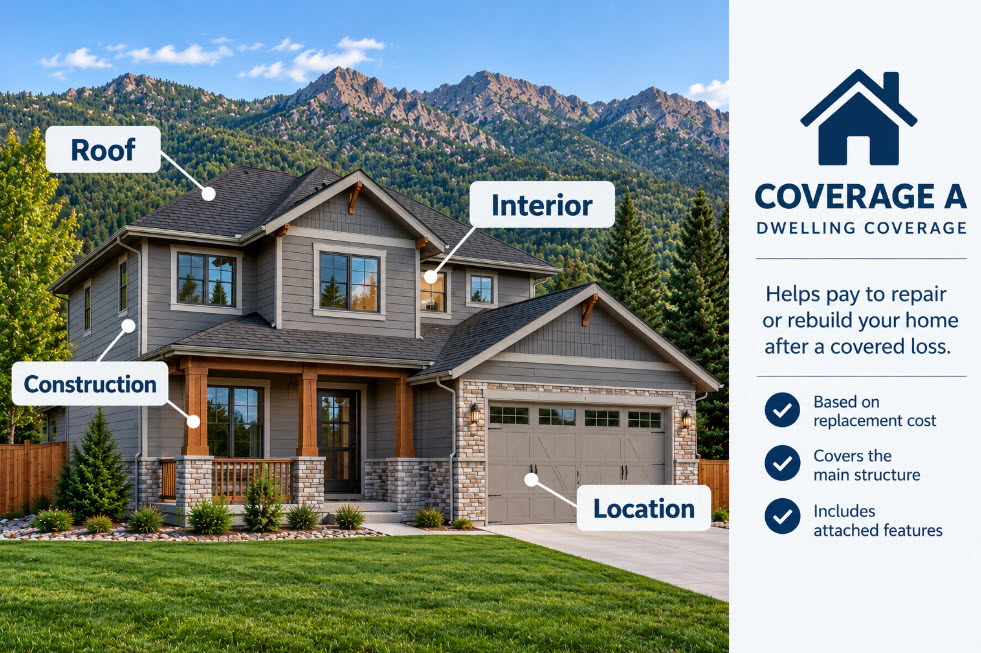
Price matters, but so does the amount of coverage you’re getting. Pay close attention to the dwelling coverage amount, also known as Coverage A. This coverage helps pay to repair or rebuild your home after a covered loss. If you’re buying a home in Colorado, understanding this number can make it much easier to evaluate a policy.
What Is Dwelling Coverage on a Homeowners Insurance Policy?
Dwelling coverage, commonly listed as Coverage A, helps cover the physical structure of your home if it is damaged by a covered loss. This generally includes the main structure and features permanently attached to it. Your dwelling limit determines how much coverage is available to repair or rebuild the home. The policy’s terms, limits and exclusions still apply.
Rebuild cost and market value are not the same. Market value includes the land and is influenced by location, housing demand and other real estate factors. Your mortgage balance is different too. Rebuild cost focuses on what it could cost to reconstruct the physical home using current labor and material costs. For example, a $750,000 home could have a dwelling limit that is lower than its market value. The opposite can also happen if the home would be particularly expensive to reconstruct.
How Do Insurance Companies Calculate Dwelling Coverage?
Insurance companies generally estimate dwelling coverage using details about the home. These can include square footage, age, number of stories, construction type, exterior materials and roof age. Interior features matter too. Finished basements, upgraded kitchens, hardwood flooring, fireplaces and custom cabinetry can all increase the estimated cost to rebuild.
Location and local construction costs also matter. Homes with greater wildfire exposure may face additional insurance considerations, including the availability and cost of Colorado wildfire insurance. It is also important to provide accurate information about the home. Incorrect square footage, outdated property details or unreported improvements can affect the replacement cost estimate.
Coverage A can vary between insurance companies. Insurers may use different replacement cost tools, property data and underwriting methods. Some variation does not necessarily mean an estimate is wrong. It does mean the dwelling limit is worth reviewing instead of judging a policy by price alone.
How Much Dwelling Coverage Do You Actually Need?
Your dwelling coverage should reflect a reasonable estimate of what it could cost to rebuild your home after a covered loss. Check that the information used to calculate the amount accurately reflects the home. Square footage, construction and major features are especially important.
It is also worth looking beyond the base Coverage A limit. Some policies offer extended replacement cost, which may provide additional coverage if rebuilding costs exceed the dwelling limit. The amount and terms vary by policy. Ordinance or law coverage can also help with certain additional costs when rebuilding requires compliance with current building codes. These protections can be especially important after a widespread Colorado wildfire, hailstorm or other event that increases demand for local labor and materials.
Ways to Save on Homeowners Insurance in Colorado
If your premium is higher than expected, lowering the dwelling coverage is not necessarily the right way to save. Start by reviewing your deductible options. Make sure the information about your property is accurate and ask about available discounts. Your credit-based insurance score may also affect your premium. An independent insurance broker can help you evaluate coverage and pricing while keeping your protection needs in mind.
Bundling may also reduce your overall insurance costs. You may be able to save by bundling home and auto insurance. Some companies also offer discounts for protective features, including qualifying home security systems. The goal is to find savings without reducing important coverage just to lower the premium.
Contact Us Today for a Free Colorado Home Insurance Quote
If you’re buying a home in Colorado or thinking about changing your current policy, Castle Rock Insurance and its partners can help. We can help you understand your dwelling coverage and estimated replacement cost. We can also help you consider Colorado-specific concerns such as hail, wildfire exposure, roof coverage and rising rebuilding costs. Contact us today for a free home insurance quote and coverage that makes sense for your home and budget.
This reads more naturally aloud now. The shorter sentences also make it much easier to scan on a phone without making the writing feel choppy.