
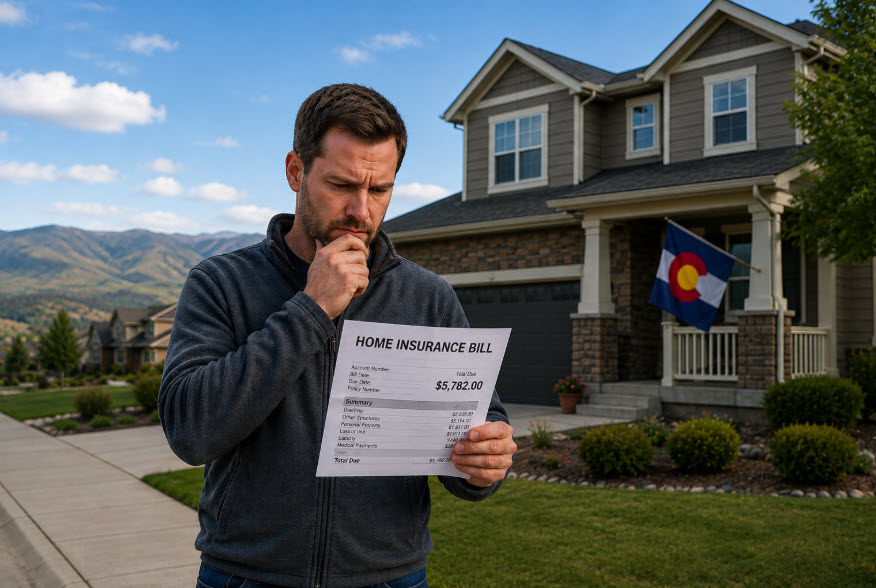
If your Colorado homeowners insurance premium has jumped again, you are not alone. Many homeowners are paying considerably more than they did just a few years ago. Hail, wildfire exposure, higher rebuilding costs and stricter property underwriting are all putting pressure on insurance costs in 2026.
For many Colorado homeowners, a reasonable 2026 planning range is approximately $4,200 to $5,200 per year. Some households will pay less, while others will pay considerably more. Your actual premium depends on the home, location, rebuilding cost, roof, wildfire and hail exposure, claims history, credit, deductibles and available insurance options.
Why Is Homeowners Insurance So Expensive in Colorado?
Colorado has several expensive property risks happening at the same time. Hail affects heavily populated communities along the Front Range and Eastern Plains. Wildfire creates a different challenge in foothill, mountain and wildland-urban interface areas. Wind, snow and freezing temperatures add to the risk. It also costs more to repair or rebuild many homes than it did several years ago.
This is why your premium can increase even if you have never filed a claim. Insurance companies look at your individual property, but they also consider the likelihood and potential cost of future losses in the surrounding area.
Hail Is a Major Cost for Colorado Homeowners
Wildfire gets significant attention, but hail remains one of the largest contributors to homeowners insurance costs across much of Colorado. Colorado insurance officials have estimated that hail risk can account for approximately 26% to 54% of homeowners insurance premiums depending on the county. One severe storm can damage thousands of roofs, siding systems, windows and vehicles.
This helps explain why insurers pay close attention to roof condition, impact resistance and wind and hail deductibles. Learn more about hail damage and homeowners insurance in Colorado.
Your Roof Can Make a Big Difference
If your premium has increased, your roof is worth a closer look. Roof age, material and condition may affect pricing, eligibility, deductibles and how a future roof claim is settled. An older roof can also reduce the number of insurance options available for a home.
If your roof has been replaced or substantially improved, keep the invoice and other documentation. Our guide explains how your roof affects homeowners insurance and why insurers pay so much attention to it.
Insurance Companies Are Looking More Closely at Your Home
Homeowners insurance underwriting has become much more property-specific. Insurers and their technology providers may use aerial imagery, public records, computer vision, catastrophe models and other information to evaluate roofs, vegetation and other characteristics of a home.
Technology does not always provide the full picture. Solar panels, shadows, staining and vegetation can sometimes make a property harder to interpret from above. Our article about AI and aerial imagery in home insurance explains what homeowners should know when technology influences an underwriting decision.
Wildfire Can Affect Price and Eligibility
If you live near forests, grasslands or open space, wildfire exposure may have a significant effect on your insurance. Insurers may consider vegetation, defensible space, slope, road access, building materials, surrounding fuels and access to fire protection.
Wildfire underwriting can be very property-specific. Two homes in the same area can receive different underwriting decisions. If wildfire exposure is limiting your options, learn more about Colorado wildfire insurance and coverage considerations for higher-risk properties.
Colorado’s Wildfire Insurance Rules Changed in 2026
HB25-1182 took effect July 1, 2026 and created new requirements for certain property insurers that use wildfire risk models, catastrophe models or scoring methods in underwriting and pricing. Among other provisions, the law gives homeowners greater transparency around wildfire risk classifications, mitigation and certain insurance decisions.
The law does not prevent insurers from using wildfire models or guarantee cheaper insurance after mitigation. It does provide homeowners with more information and a process for challenging certain wildfire risk determinations. The legislation is available through the Colorado General Assembly.
Colorado Is Putting More Focus on Stronger Roofs
Senate Bill 26-155 created the Strengthen Colorado Homes Enterprise in 2026. The program supports efforts aimed at stronger and more resilient homes, including qualifying roof improvements. The broader goal is to reduce the severity of future property losses.
A newer or more resilient roof does not automatically mean a lower premium. Discounts and underwriting guidelines vary by insurer. Still, stronger roofing and good documentation can be valuable when your home is being evaluated.
Higher Rebuilding Costs Can Raise Your Insurance
Another reason your premium may be rising is the estimated cost to rebuild your home. This is different from its market value, purchase price or mortgage balance. Rebuilding cost focuses on the physical structure and what current labor and materials could cost after a covered loss.
This estimate helps determine your dwelling coverage, commonly called Coverage A. As reconstruction costs increase, the amount of insurance needed to rebuild the home may increase too. Our guide to dwelling coverage explains how this amount is determined and why it can be very different from your home’s market value.
Claims and Credit Can Affect What You Pay
Claims history can affect both pricing and eligibility. Insurers may consider the type of claim, how recently it occurred, the amount paid and whether multiple losses occurred within a relatively short period. One isolated claim does not necessarily make a home difficult to insure.
Many insurers also use a credit-based insurance score as one rating factor. This is not necessarily the same score you see through a bank or credit-monitoring service. Learn more about credit and Colorado insurance rates.
A Cheaper Premium Is Not Always a Better Deal
When insurance gets expensive, it is natural to focus on the premium. Just make sure you understand what comes with that price. Wind and hail deductibles, roof settlement provisions, dwelling coverage and important exclusions can make a major difference after a claim.
For example, a 2% wind and hail deductible applied to a $600,000 dwelling limit would equal $12,000 when that deductible applies, subject to the policy terms. A lower annual premium may be less attractive if it comes with a much larger deductible or significantly different coverage.
Why Can Insurance Pricing Vary So Much?
Insurance companies do not all evaluate a home the same way. Each company has its own rates, underwriting guidelines, catastrophe models and preferences. One insurer may be comfortable with your roof, wildfire exposure or claims history while another may charge more or decline the property.
This is where an independent insurance broker can be helpful. A large renewal increase reflects one insurer’s current pricing and evaluation of your home. It does not necessarily mean every available insurance option will treat the property the same way.
Can Bundling Home and Auto Insurance Help?
Bundling can be one practical way to reduce your overall insurance costs. Many companies offer multi-policy discounts when home and auto coverage are written together. Some insurers may also be more interested in the overall household when they can insure both the home and vehicles.
The total cost and coverage still need to make sense for you. Learn more about home and auto insurance bundle discounts in Colorado.
What Can You Do If Your Home Insurance Is Too Expensive?
If your premium has become difficult to manage, start with the things you can realistically review or improve:
- Review your deductible and understand how much you would pay after a claim.
- Make sure your insurer has accurate information about your home.
- Keep documentation of roof replacements and major improvements.
- Document wildfire mitigation and defensible-space work when applicable.
- Ask about eligible multi-policy and protective-device discounts.
Try not to solve a high premium simply by cutting important coverage. The goal is to find reasonable savings while keeping protection that makes sense for your home and financial situation.
Will Colorado Homeowners Insurance Get Cheaper?
There are some encouraging developments. Colorado is putting more emphasis on resilient roofing, wildfire mitigation and transparency around catastrophe-risk models. Efforts that reduce future property losses could help improve the insurance market over time.
However, Colorado will continue to face hail, wildfire and high rebuilding costs. Homeowners should not expect premiums to quickly return to the levels seen several years ago.
What If Your Homeowners Insurance Is Nonrenewed?
A nonrenewal does not necessarily mean your home is uninsurable. It may reflect one insurer’s roof requirements, wildfire appetite, catastrophe exposure or other underwriting guidelines. Start by finding out exactly why the policy is being nonrenewed. Updated photographs, inspection reports, roof documentation or mitigation records may help depending on the issue.
If the insurer will not reconsider, other options may still be available. Our guide explains what to do if your homeowners insurance is dropped in Colorado.
Get Help With Colorado Homeowners Insurance
If your homeowners insurance has become too expensive, you do not have to navigate Colorado’s insurance market on your own. Castle Rock Insurance and its partners can help review your situation, explain available options and identify factors that may be affecting your premium. Whether you are dealing with a large renewal increase, buying a home or having difficulty finding coverage, contact us for help with your Colorado homeowners insurance.